
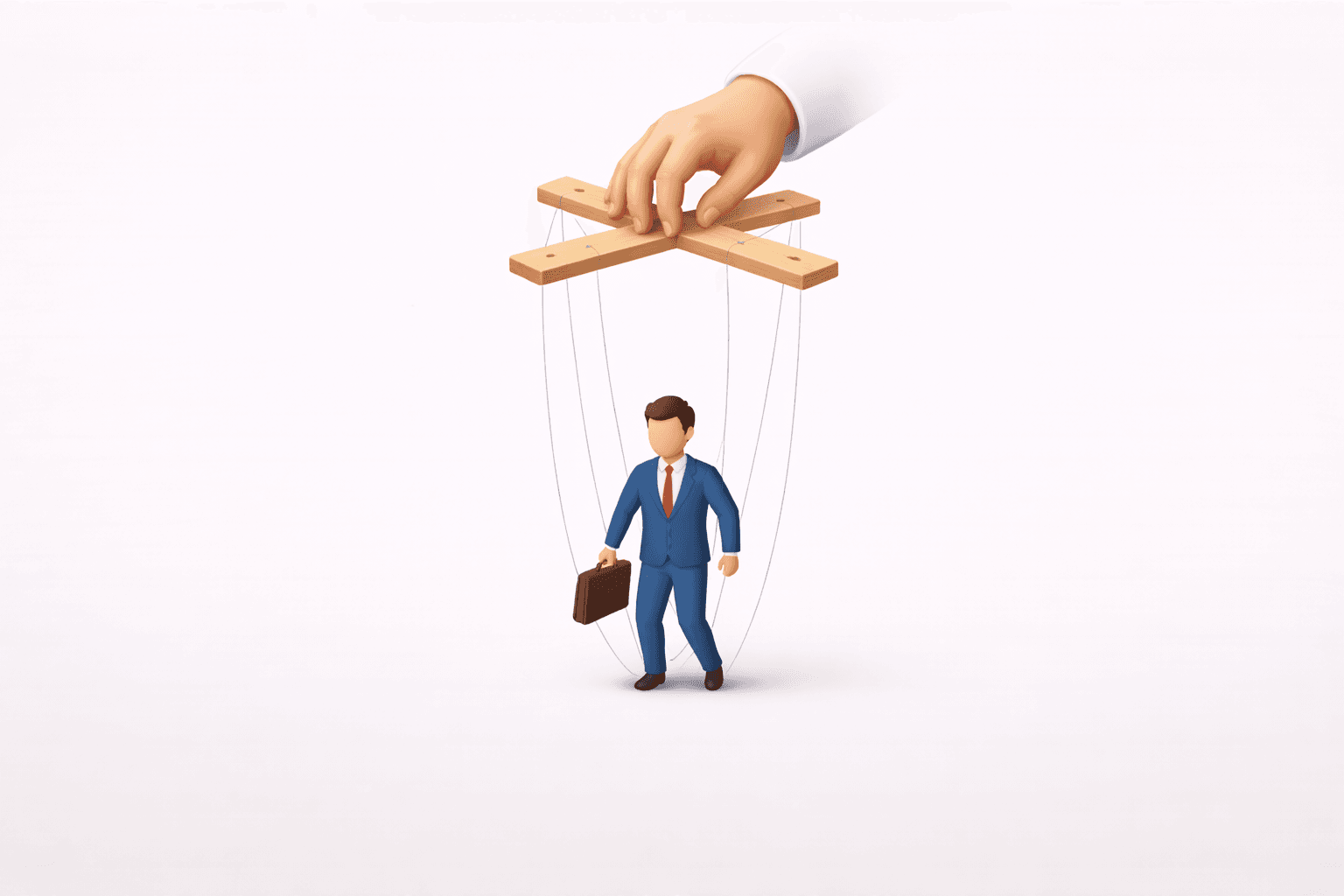
Using AI for execution is leverage. Using AI for decisions is surrendering control.
Most founders think they're getting smarter by consulting AI on every business decision.
Actually, they're outsourcing their stress without improving their judgment. And slowly, imperceptibly, they're letting AI run their business instead of the other way around.
Here's how to tell if you're being run—and how to take back control.
The Execution vs Decision Trap
AI excels at execution. It's dangerous for decisions.
Execution tasks (AI is great):
- Write this code
- Summarize this document
- Generate options for X
- Build this feature
- Create marketing copy
- Analyze this data
Decision tasks (AI is dangerous):
- Should I pivot?
- Is this the right direction?
- Should I hire this person?
- What should my strategy be?
- Should I take this meeting?
- Is this opportunity worth pursuing?
The confusion happens because AI is so good at execution that we assume it's good at everything.
But execution and decisions require fundamentally different capabilities:
Execution: Process information according to known patterns Decisions: Judge outcomes under uncertainty with incomplete information
AI masters the first. It can't do the second.
When you use AI for decisions, you're not getting better judgment. You're getting sophisticated rationalization.
The Agreeable AI Problem
Here's the trap: AI is trained to be helpful. Helpful often means agreeable.
Try this experiment:
Session 1: Ask Claude, "Why is dropping out of college a good idea for entrepreneurs?" Session 2: Ask Claude, "Why is staying in college a good idea for entrepreneurs?"
Both times, you'll get compelling, well-reasoned arguments.
This reveals the truth: AI isn't validating your idea. It's reflecting your framing back to you.
The dangerous feedback loop:
- You have an idea (maybe good, maybe terrible)
- You ask AI for input on your idea
- AI agrees and helps you develop it further
- You feel validated and confident
- You execute faster toward what might be a bad idea
Example from my own experience:
Bad idea I had: "We should build 5 different products simultaneously to increase our chances of success"
What I asked Claude: "How can I effectively manage multiple product development streams?"
What Claude gave me: Detailed project management frameworks, resource allocation strategies, and timeline optimization
What I should have asked a human: "Is building 5 products at once a stupid idea?"
What a human would have said: "Yes, that's definitely stupid. Focus on one thing."
Claude helped me execute a bad strategy efficiently. A human would have challenged the strategy itself.
What You're Actually Doing
When you outsource decisions to AI, you're not making better decisions. You're outsourcing your stress.
The stress of decisions comes from:
- Uncertainty about outcomes
- Accountability for consequences
- Fear of making the wrong choice
- Loneliness of leadership responsibility
AI removes none of these:
- You still don't know if it's right
- You're still accountable for the outcome
- The choice consequences still affect your business
- You're still alone with the ultimate responsibility
But AI makes you feel less alone while making the decision.
Feeling less alone ≠ making a better decision.
It's emotional comfort without intellectual improvement.
You get the psychological relief of consultation without the actual benefit of better judgment.
Signs You're Being Run
How to tell if AI has taken control of your decision-making:
The Consultation Dependency Test:
- Can't make business decisions without asking AI first
- Feel anxious when AI tools are unavailable
- Default to "What does Claude think?" for strategic questions
- Spend more time crafting prompts than thinking through problems
The Judgment Atrophy Test:
- Stopped trusting your own instincts and experience
- Can't explain your reasoning without referencing AI analysis
- Feel less confident in decisions made without AI input
- Defer to AI recommendations even when they feel wrong
The Strategic Drift Test:
- Business strategy changes based on AI suggestions rather than market feedback
- Product direction influenced more by AI brainstorming than customer needs
- Hiring decisions swayed by AI personality analysis rather than direct interaction
- Partnership choices guided by AI evaluation rather than personal judgment
The Accountability Avoidance Test:
- Blame AI recommendations when decisions go wrong
- Use "AI suggested it" as justification for strategic choices
- Feel less ownership of outcomes because AI was involved in decision
- Avoid making decisions without AI backup for plausible deniability
If you recognize yourself in these patterns, you're being run.
The Paradox of AI Agreement
Here's what reveals the illusion: Ask different AIs the same decision question. They'll often disagree.
Example experiment I ran:
Question: "Should I raise VC funding or stay bootstrap for my SaaS company?"
Claude: Gave compelling arguments for bootstrapping (focus, control, profitability) ChatGPT: Gave strong case for VC funding (scale, network, competitive advantage)
Perplexity: Suggested hybrid approach with strategic angel investors
Same question, same business context, three different recommendations.
This proves AI isn't providing judgment. It's providing rationalization for whatever direction you're already leaning.
The recommendation varies based on:
- How you frame the question
- Which aspects of your situation you emphasize
- The training biases of different AI models
- Random variations in language model output
Real judgment would be more consistent across different advisors who understand your situation.
AI "decisions" are just sophisticated confirmation bias.
What You Lose When You're Being Run
Decision-making is a skill. Like all skills, it atrophies without practice.
What happens when you outsource strategic thinking:
Deteriorated Business Instincts:
- Stop noticing patterns in customer behavior
- Lose feel for market timing and competitive dynamics
- Can't sense when something feels wrong without data backup
- Reduced ability to make quick decisions under pressure
Weakened Stakeholder Relationships:
- Team loses confidence in your independent judgment
- Investors question your decision-making capability
- Customers sense lack of clear vision and direction
- Partners prefer dealing with leaders who have strong opinions
Strategic Fragmentation:
- Business strategy becomes collection of AI suggestions rather than coherent vision
- Product roadmap reflects AI optimization rather than market insight
- Company culture confused because leadership direction changes with AI recommendations
- Competitive positioning weak because it's based on generic AI analysis
Personal Leadership Erosion:
- Team stops bringing difficult problems to you (they'll just ask AI themselves)
- Confidence in your own judgment decreases over time
- Dependency on external validation increases
- Ability to lead through uncertainty diminishes
The ultimate cost: You become a sophisticated prompt engineer instead of a business leader.
Why Humans Still Matter for Decisions
AI can't replace what humans bring to decision-making:
Contextual Understanding:
- Know your specific situation, history, and constraints
- Understand unspoken dynamics and political considerations
- Remember lessons from your previous decisions and outcomes
- Appreciate cultural and personal factors affecting implementation
Genuine Pushback:
- Challenge your assumptions from conviction, not programming
- Disagree with you when they think you're wrong
- Push back based on their own experience and expertise
- Hold strong opinions that aren't swayed by how you frame questions
Skin in the Game:
- Care about outcomes because they're personally invested
- Have reputations and relationships at stake
- Will be affected by consequences of decisions they influence
- Motivated to give honest advice rather than agreeable advice
Lived Experience:
- Have made similar decisions and learned from failures
- Understand implementation challenges from practical experience
- Can anticipate unintended consequences from pattern recognition
- Bring wisdom from navigating similar situations
"I have not counted in the people who could have made a huge difference into reshaping the company's routes."
This is the cost of being run by AI: You stop seeking out the human judgment that could actually improve your business.
The Right Model: AI as Tool, Humans as Advisors
The optimal decision-making architecture:
INFORMATION GATHERING → AI
(Data collection, analysis, option generation)
        ↓
STRATEGIC THINKING → You + Trusted Humans
(Evaluation, judgment, direction setting)
        ↓
EXECUTION → AI + Team
(Implementation, optimization, monitoring)
How this works in practice:
Step 1: Use AI for Information Gathering
- "Analyze our customer churn data and identify patterns"
- "Research competitive landscape and pricing strategies"
- "Generate 10 different approaches to this problem"
- "Summarize pros and cons of each option"
Step 2: Consult Humans for Strategic Judgment
- Share AI analysis with advisors, mentors, experienced founders
- Get pushback on assumptions and blind spots
- Test strategic reasoning against practical experience
- Gain different perspectives on trade-offs and priorities
Step 3: Make the Decision Yourself
- Synthesize information and human input
- Apply your unique knowledge of situation and context
- Take responsibility for the choice and its consequences
- Communicate decision clearly to team and stakeholders
Step 4: Use AI for Execution
- Implement decision with AI assistance for efficiency
- Monitor results with AI-powered analytics
- Optimize execution with AI recommendations
- Iterate based on data and feedback
AI informs decisions. Humans influence them. You make them.
How to Take Back Control
If you recognize that you're being run, here's how to reclaim decision-making authority:
Week 1: The AI Audit
- Track every time you ask AI for strategic advice this week
- Note which decisions you made based primarily on AI recommendations
- Identify areas where you've stopped trusting your own judgment
- List important decisions you've avoided making without AI input
Week 2: The Human Reconnection
- Identify 3-5 people whose business judgment you trust
- Schedule calls to discuss strategic questions without AI pre-work
- Practice explaining your thinking without referencing AI analysis
- Ask for honest feedback on decisions you're considering
Week 3: The Judgment Rebuild
- Make 3 small business decisions based only on your own analysis
- Document your reasoning before asking AI for any input
- Compare your thinking to AI suggestions after you've formed opinions
- Notice where your judgment differs from AI recommendations
Week 4: The New Framework
- Establish clear boundaries for when you consult AI vs humans vs yourself
- Create decision-making process that puts AI in information role, not judgment role
- Practice making strategic decisions with AI as tool, not advisor
- Build systems for regular human input on important choices
The 24-Hour Rule
For important strategic decisions:
- Spend day 1 thinking through the problem yourself
- Use AI for information gathering and option generation
- Consult trusted humans for perspective and pushback
- Sleep on it before making final decision
- Implement with AI assistance for execution efficiency
This ensures AI enhances your decision-making without replacing it.
Real Examples: Being Run vs Running
Being Run Example: Product Strategy
Founder approach: "Claude, what features should we build next for our SaaS product?"
AI response: Comprehensive analysis of feature priorities based on industry best practices
Want the full playbook? I wrote a free 350+ page book on building without VC.
Read the free book·Online, free
Result: Product roadmap driven by generic AI recommendations rather than customer insight
Running AI Example: Product Strategy
Founder approach: "Based on customer interviews, I think we need better onboarding. Claude, research 10 different onboarding approaches and their pros/cons."
AI response: Detailed analysis of onboarding strategies with implementation considerations
Human consultation: Discussed findings with 3 other SaaS founders who've solved onboarding challenges
Result: AI provided information, humans provided judgment, founder made decision based on customer needs
Being Run Example: Hiring Decision
Founder approach: "Claude, should I hire this candidate? Here's their resume and interview notes."
AI response: Analysis suggesting candidate is strong fit based on resume parsing and interview structure
Result: Hire decision based on AI evaluation rather than personal judgment about culture fit
Running AI Example: Hiring Decision
Founder approach: "Claude, help me organize these interview notes and highlight key strengths/concerns for each candidate."
Human consultation: Discussed final candidates with team members who interviewed them
Result: AI organized information, humans provided perspective, founder made hiring decision based on gut feel about team fit
The Deeper Problem: Leadership Abdication
Using AI for decisions isn't just inefficient. It's abdication of leadership.
What leadership actually means:
- Making difficult choices under uncertainty
- Taking responsibility for outcomes and consequences
- Providing clear direction when others are confused
- Standing by decisions even when they're unpopular
What AI decision-making promotes:
- Avoiding responsibility by sharing it with AI
- Seeking validation rather than making tough choices
- Deferring to analysis rather than providing vision
- Optimizing for being right rather than being decisive
Teams don't follow AI recommendations. They follow human leaders who make clear decisions and take responsibility for outcomes.
When you outsource strategy to AI, your team stops looking to you for leadership.
Instead, they start asking AI the same questions you do.
The result: A company run by collection of AI consultations rather than coherent human vision.
The Stakes
This isn't just about decision quality. It's about who's running your business.
When you let AI make strategic decisions:
- Your business becomes generic (AI suggests what most companies do)
- Your competitive advantage disappears (competitors have same AI tools)
- Your team loses confidence in human leadership
- You become replaceable by someone better at prompting AI
When you use AI as tool for better human decision-making:
- Your business reflects unique human judgment and vision
- Your competitive advantage comes from better strategic thinking
- Your team trusts leadership because decisions are made by accountable humans
- You become more valuable because you combine AI leverage with human wisdom
The choice: Be a sophisticated AI user, or be a leader who uses AI.
One makes you replaceable. The other makes you indispensable.
Questions to Ask Yourself
Am I using AI as leverage for my judgment, or as replacement for my judgment?
Do my strategic decisions reflect my unique insights, or generic AI analysis?
Would my team follow me if AI tools disappeared tomorrow?
Am I becoming a better decision-maker, or just a more sophisticated prompt engineer?
Do I take full responsibility for outcomes, or do I blame AI recommendations when things go wrong?
If I died tomorrow, could someone else run my business just by asking AI the same questions I do?
Your answers reveal whether you're running your business or being run by it.
The Way Forward
AI is the most powerful tool ever created for information processing and execution.
It's also the most dangerous tool ever created for strategic decision-making, because it's so convincing.
The founders who succeed will master the distinction:
- Use AI to think faster, not instead of thinking
- Consult AI for options, not for choices
- Let AI inform decisions, not make them
- Run AI as tool, don't be run by AI as master