
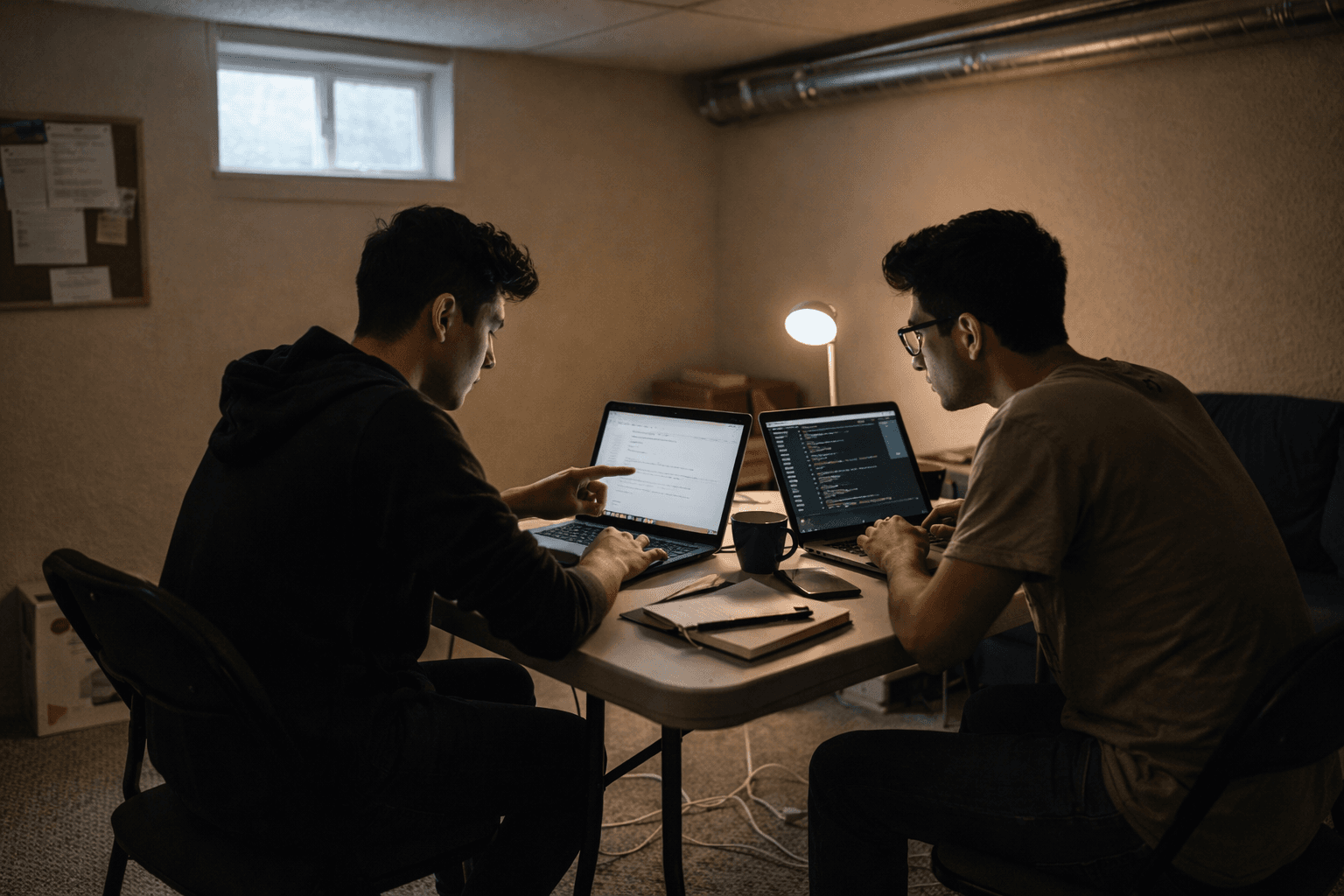
My first real business started in Arashdeep's basement in 2019.
We had no money. We had no customers. We had no business plan. What we had was each other, and that made all the difference.
Not because two people are always better than one. But because one person cannot be two people at the same time.
The Lonely Default
The solopreneur narrative is everywhere now. It's trendy. It's empowering. A single person with a laptop changes the world, asks no permission, needs no one.
What's never talked about is the darkness.
Running a company alone means that every decision you make, only you see it. You're the optimist and the pessimist. You're the voice pushing forward and the voice asking if you're insane. You're the person who disagrees with yourself.
That's a problem.
When I was with Arashdeep, we'd fight about product direction. We'd argue about features. He'd want to build something I thought was stupid. I'd want to go a different way that he'd punch holes in immediately. We'd come to a decision not because one of us convinced the other, but because the friction of our disagreement actually pointed at the truth.
Solo, there's no friction. There's just you and whatever narrative you've decided is real today.
The Execution vs. Direction Problem
Now I have AI. I can do what used to take a team of five. I can write code, I can design, I can build infrastructure, I can manage operations. AI is the co-founder I can hire for the execution.
But AI can't redirect the company.
That's what a co-founder actually does. Not the 60% of work that's execution. The 10% that's direction.
When you're alone, you get faster. You ship more. You iterate quicker. But the direction you're moving in? You can only see that direction through your own eyes.
I've watched solopreneurs build beautiful things that nobody wanted. Perfect execution. Wrong place. No one to say "wait, maybe we're building the wrong thing."
That's not a feature of being solo. That's the dark side.
Echo Chambers With Faster Execution
Here's what happens when you take a smart solo operator and give them AI tools: you get really efficient wrongness.
You're running fast. You're building fast. You're iterating fast. But if you're iterating on the wrong thesis, speed is the worst thing that could happen to you.
I've seen it in my own work. I'll go deep on a problem for weeks, build something really elegant, and then Arashdeep will say one sentence that makes me realize the whole thing was solving the wrong problem.
One sentence. From someone else. That redirects everything.
When you're solo, you need to manufacture that sentence yourself. You need to be your own opponent. But you already know your own arguments. You already know how you'll respond. There's no real disagreement. There's just you playing chess against yourself.
You always win. That's the problem.
Why I Started With a Co-Founder
I was 22. I could've built something solo in my dorm room. I had the skills. I had the time. I had the energy.
But I knew I'd need someone to argue with. Someone to say "that's stupid" when I was building stupid things. Someone to push back on my terrible ideas before I wasted three months building them.
That was the real value of having a co-founder. Not the doubled output. The doubled thinking.
Arashdeep and I would argue about everything. It was exhausting. It was also the only reason we actually built something people used instead of something I thought was clever.
The Scale of the Problem
Here's the thing: if you're a solo operator, you can still win. You can build something real. You can make money. You can be independent.
But you're optimizing for wrong things. You're optimizing for speed, independence, and control. You're not optimizing for truth.
And the truth is the thing that actually determines if your business survives.
What The Solopreneur Narrative Gets Right
Before I criticize, I'll give it its due: the solopreneur movement has freed a lot of people from the tyranny of corporate jobs. It's proven that you don't need permission, investment, or organizational structure to build something valuable.
That's real. That matters.
Want the full playbook? I wrote a free 350+ page book on building without VC.
Read the free book·Online, free
And for some people, solo is actually the right move. Some people work better alone. Some people have such a clear vision and such a proven track record that they're the best direction-setter for their own company.
But those people are rare. And they usually don't realize they're rare.
The Quiet Evolution
I used to think about this as a binary. Either you have a co-founder or you're solo.
I've started to think it differently now. The real spectrum is: How many people do you have thinking about the direction of the business?
With a co-founder, it's two. With a small team, it's more. Alone, it's one. But one is the dangerous spot.
Maybe the answer isn't "go back to hiring 14 people." Maybe the answer is "add one person who thinks differently than you." Not to execute. To argue.
To be the voice that says "wait, are we sure?"
What I'd Do Differently
If I started something new tomorrow, I wouldn't go solo. Not because I can't execute solo. Because I know what I lose when I do.
I wouldn't hire a big team either. I'd find one person who disagreed with me consistently. One person who made me defend my ideas. One person who could see around the corners I was missing.
That person is worth more than an entire team of people executing my vision perfectly.
The beautiful execution doesn't matter if you're executing the wrong thing.
The Honest Version
The solopreneur life isn't what they show you on Twitter. It's not laptop on beach, freedom, independence, no meetings.
It's also: decision paralysis. It's loneliness. It's the echo chamber of your own thoughts. It's being really confident in the wrong direction. It's shipping fast and realizing six months later you built the wrong product.
It's solvable. You can hire advisors. You can seek feedback. You can join masterminds.
But you're manually fighting against your default nature, which is to make sense to yourself.
With a co-founder, the friction is built-in. The argument is automatic. The reality check is structural, not optional.
The solopreneur myth promises freedom. It delivers efficiency. They're not the same thing.
Choose wisely based on what you actually need, not based on what's trendy.
The Only-Defensible Category
Here's my controversial take: in the next decade, solopreneur will become the only defensible category for bootstrap businesses. Not because it's good. Because AI will make hiring pointless for execution.
But that doesn't make it easy. And it doesn't make it good for everyone.
You might be brilliant enough to direct yourself. You might be strategic enough to catch your own errors. You might be ruthless enough to kill your own sacred cows.
Most of us aren't. Most of us need someone to tell us we're wrong.
And that's okay. That's not weakness. That's just being human.