-1754757174784.jpg&w=128&q=75)
The old playbook is dead.
For years, we've been told the same story: raise millions, hire 20+ people, move to San Francisco, burn $500K/month, and hope you find product-market fit before the money runs out.
That worked when information moved slowly, when you needed physical proximity to coordinate, when AI tools didn't exist.
Not anymore.
I'm running two profitable companies from Toronto with 5 people. No VC. No San Francisco office. We're competing with 50-person teams that have raised millions. And we're winning.
Here's the framework that actually works in 2025.
The Death of Machine, Platform, Crowd
Back in 2015-2017, I read Machine, Platform, Crowd. The thesis was simple: you need a machine (servers doing work), a platform (marketplace or SaaS), and a crowd (audience).
It made sense then. It's outdated now.
The world changed after ChatGPT launched in November 2022. The economics of building companies fundamentally shifted. What used to require massive teams and capital can now be done by small, efficient teams leveraging AI.
The new framework isn't about machines and platforms anymore.
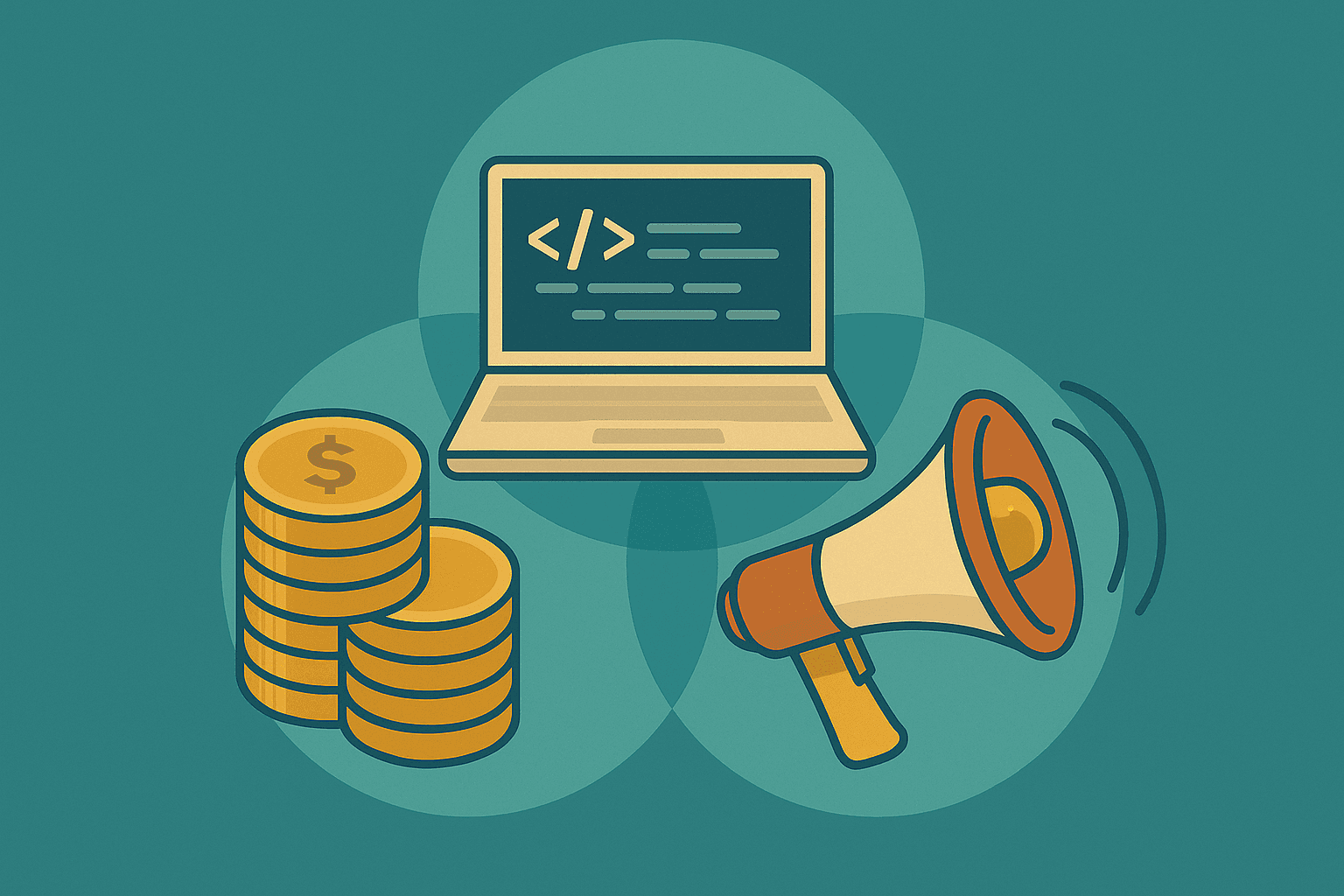
It's about Capital, Code, and Audience.
But not the old definitions. These have been transformed by AI in ways most founders haven't figured out yet.
Capital: Efficiency Over Amount
Capital isn't about how much money you have. It's about how efficiently you deploy it and how long you can keep it working.
The Old Way (Expensive)
- Raise $5M from VCs
- Hire 20 people immediately
- Get fancy office in SoMa ($10K+/month)
- Burn $200-500K/month
- Hope you find PMF before dying
The New Way (Efficient)
We built SimpleDirect's initial product for under $20,000. Not $5M. Not even $1M. Twenty thousand dollars.
Here's how:
No office for the first few years. When we finally got one, it was flexible desks, not expensive dedicated space. I see pre-revenue startups spending thousands monthly on offices. That's capital inefficiency.
We went from 14 people to 5. At our peak, we had 14 employees. The coordination overhead was crushing - 91 possible communication paths. We scaled down to 5 people and started moving faster than ever. Saved hundreds of thousands in salaries.
AI tools over new hires. We spend ~$8K/year on AI tools versus $200-300K per person. Strategic automation, not replacement.
Toronto over San Francisco. We're 40% cheaper than SF/NYC. That's over $100K saved annually on rent, salaries, and cost of living. And we're still not cheap - Bali, Thailand, or Latin America would be even better.
The Capital Liquidity Test
Ask yourself three questions:
- Can you deploy your capital anywhere quickly?
- Can you reposition if something isn't working?
- Does it compound without constant time investment?
If you're running a consulting business or retail store that can't operate without you, you're failing the capital liquidity test.
We currently have 50+ months of runway. Not because we raised a ton of money. Because we're ruthlessly efficient with costs.
The more efficiently you deploy capital, the longer your runway, and the more freedom you have to pivot when something doesn't work.
That's what capital efficiency actually means.
Code: Direction Over Implementation
"But George, I don't know how to code."
Perfect. You don't need to anymore.
The Old Belief (Wrong)
- You need 4-5 years of CS education
- You need a technical co-founder
- You need to write thousands of lines of code yourself
- Non-technical founders can't run tech companies
The New Reality (True)
After AI went mainstream, code became about direction, not implementation.
Think of yourself as a film director, not a cameraman. The director doesn't operate the camera, but they know exactly what shot they want, how it fits the story, and whether the cameraman got it right.
That's you with AI tools now.
I personally haven't shipped production code in 2.5 years. But I review code consistently. I understand our architecture. I know what we're building. I can direct developers effectively.
If my developers leave tomorrow, I'm not blind. That's the difference.
My AI-First Stack
Cursor - Primary development tool. Free tier. Tell it what to build, review the code, approve or reject. Think of it as a junior developer who needs oversight.
Claude - Strategy, brainstorming, content, problem-solving. I've specifically instructed Claude to be brutally honest with me. It's replaced many co-founder brainstorming functions.
ChatGPT - General problem-solving and some automation.
Chatwoot - Customer support automation. We're working toward 100% automated support.
GitHub Copilot - Code assistance for our developers.
MCP Servers - Gives AI context about our business complexity. (I'll link to resources below if you're not familiar.)
What AI Actually Replaced
I started with 5 co-founders (including me). Now it's just me and one other co-founder. Two people.
Here's what AI + contractors replaced:
- Technical validation → Cursor + Claude can validate most decisions
- Product feedback → Customer interviews + AI analysis
- Content creation → 99% my voice, Claude amplifies distribution
- Customer support → Chatwoot automation (working toward 100%)
- Code execution → Two developers in India + AI tools
- Strategic planning → Claude + ChatGPT + my frameworks
We went from 6 engineers to 2. If we can do it, so can you.
The Math Silicon Valley Doesn't Want You To See
You don't need five co-founders. You don't need a huge dev team. You don't even need a massive sales team.
One person + $500/month in AI tools + strategic contractors > five co-founders burning through equity and causing coordination overhead.
Before you hire anyone or bring on another co-founder, ask:
Can AI do this? Can AI + a contractor solve this?
If yes, you just saved yourself equity and complexity.
The goal isn't to replace all humans. It's to be brutally honest about what actually requires human judgment versus what can be automated.
Audience: Trust Over Size
When most people hear "audience," they think: I need a million followers like MrBeast or Logan Paul. I need to be an influencer. I need to sell courses.
All wrong.
Audience means a group of people who trust you enough to listen when you have something to say.
This could be 200 people. This could be 200,000 people.
Size matters less than trust and reputation.
Why This Is Your Superpower
Most founders we consult through ANC don't have distribution. So we teach them cold outreach on LinkedIn.
The reality: 100 cold messages = 2-5 responses (2-5% response rate).
Or they pay $10-50K for conference booths to hand out 200 business cards.
Or they burn money on Google Ads, Facebook Ads, TikTok Ads, trying to buy attention.
All expensive. All slow. All dependent on external platforms you don't control.
The Alternative
I have 30,000 followers on Twitter/X. When I tweet about SimpleDirect or ANC, thousands of people see it immediately. Last week, one post hit 150,000 impressions.
Zero ad spend. Zero conference fees. Zero cold outreach.
I don't need TechCrunch to write about me. I don't need a $5K/month PR agency (almost made that mistake, thank God I didn't). I don't need Y Combinator validation. I don't need conference organizers to give me a stage.
I already have an audience that opted in to hear what I have to say.
That's the power of owned distribution.
It's Not About Follower Count
I see accounts with 200K followers getting 50 likes per post. They have following, but not trust.
Meanwhile, someone with 500 engaged followers who actually listen and trust them? That's more valuable.
If you're posting memes to get to 500K followers, the value to you is almost zero (unless you're selling ads). But if you're building a personal brand in a specific niche and get to 500 followers who care about your message? Those are 500 people who will listen when you launch something.
Want the full playbook? I wrote a free 350+ page book on building without VC.
Read the free book·Online, free
That's the audience that matters.
Start Before You Need It
The biggest mistake founders make: "I'll build an audience after I launch my product."
Wrong.
You need to start building your audience before you have something to sell.
Here's why: Audiences don't trust products. Audiences trust people.
We follow founders, not companies. We follow stories, not brands.
Everyone has a story. Your childhood, your struggles, your journey - anything can be a story. It doesn't have to be dramatic. It just has to be authentic.
I started actively posting on Twitter in 2023. For the first few months, I had no likes, no impressions, nothing. It felt like shouting into a mountain with nobody listening.
But I kept going. One post a day.
Two years later: 30K followers, consistent engagement, owned distribution.
The worst part about building an audience isn't that it's hard. It's that you should have started five years ago.
I started my entrepreneurial journey in 2019. I didn't start building an audience until 2023. That's 3-4 years wasted. It's one of my biggest regrets.
Don't wait like I did. Start today.
Rented vs. Owned Audience
Rented Audience:
- Twitter/X
- YouTube
- TikTok
- Subject to algorithm changes, platform rules, potential bans
Owned Audience:
- Email newsletter
- Podcast subscribers
- Direct relationships
The Strategy:
Start with rented platforms (Twitter, LinkedIn) because they have existing audiences and discovery mechanisms. You need the initial boost.
Once you have traction, prioritize building owned distribution (newsletter, podcast) so you're not at the mercy of algorithms.
I recently started my newsletter two months ago. I'm also building this podcast. These are owned channels where I control the relationship.
Start rented. Transition to owned. Maintain both.
What Doesn't Matter Anymore
Headcount Is Overrated
More people ≠ more output.
If you've worked at a big company, you know this. Employees slack off. Coordination overhead kills velocity.
At our peak, we had 14 people for a company making $30-40K/month. Completely insane.
Letting everyone go was the lowest moment of my life. But I learned: I actually don't need that many people.
I was trying to fit in. Trying to play the startup game. But that's not the path I wanted.
Now we're 5 people running two companies profitably.
With 14 people, there are 91 possible communication paths.
With 5 people, there are 10.
When I have an idea, I know exactly who to talk to. No bureaucracy. No layers.
Add AI to the equation, and headcount matters even less.
Geography Doesn't Matter (Mostly)
Yes, location matters for networking and finding mentors. That's still valuable.
But you don't have to live in San Francisco to build a successful tech company.
I'm building in Toronto - not a tech hub, not a SaaS hub. But I'm finding success here because:
- Lower cost of living
- Support network is here
- 40% cheaper than SF = $100K saved annually
- I still travel to SF/NYC a few times a year for strategic networking
I've closed deals with SF VCs over Zoom. I've spoken at SF accelerators remotely. My podcast reaches more founders than local meetups ever could.
You can build in Bali, Beijing, Tokyo, Buenos Aires, Lisbon, Mexico City - anywhere with lower cost of living than the US/Canada/UK.
Build where your capital lasts longest. Travel strategically for relationships.
The networking argument for SF was valid when information moved slowly and you needed in-person serendipity. Now? Zoom, Twitter DMs, and async communication work just fine
The Three C's: Your Action Framework
Capital Audit
- Can you deploy capital anywhere quickly?
- Can you reposition if something's not working?
- Does it compound without your constant time?
- How many months of runway do you have?
Action: Cut expenses ruthlessly. Extend runway to 36+ months if possible.
Code Audit
- Do you understand your tech stack enough to direct it?
- Are you using AI strategically or randomly?
- Can AI + contractors replace functions you're considering hiring for?
- Could you redirect your developers if they needed to pivot tomorrow?
Action: Learn enough to read code. Use Cursor or Claude to start building without a technical co-founder.
Audience Audit
- Could you reach 100 ideal customers in 48 hours?
- How many people would pay attention if you launched something today?
- Are you building trust or just collecting followers?
- Do you own the relationship (email/podcast) or just rent it (Twitter)?
Action: Start building audience today. One post per day on Twitter. Start a newsletter in 90 days.
The Bottom Line
Legacy playbook: Optimize for headcount and geography.
This worked for 50 years because big teams were necessary and information moved slowly.
But big teams are expensive now. Most of us don't have the luxury of raising millions. And even if we could, it might not be the best path.
In 2025, one person with:
- Capital that's liquid and efficiently deployed
- Code capabilities multiplied through AI
- Audience that trusts and supports them
Can out-compete a 50-person team in a fancy San Francisco office.
My companies are proof. Yours can be too.
The shift from Machine, Platform, Crowd to Capital, Code, Audience is the future.
Run your Three C's audit. Fix what's broken. Double down on what's working.
Resources
Follow the journey:
- Twitter/X: @TheGeorgePu
- Newsletter: newsletter.founderreality.com
- Website: founderreality.com
Free book: The Anti-Unicorn: The Consulting Way - Includes detailed guide on building audience from zero
AI Tools Mentioned:
- Cursor - AI-first code editor
- Claude - Strategy and brainstorming
- Chatwoot - Customer support automation
- MCP Servers - Learn more about Model Context Protocol
This is George Pu. I'm building SimpleDirect and ANC from Toronto with 5 people. No VC. No SF office. Just capital efficiency, AI leverage, and owned audience.
The old rules don't apply anymore. The question is: will you adapt or keep playing the expensive game?